Is Char Dham Yatra Safe at 70? An Honest Answer
Every year, the call comes to our Rishikesh office. “Mere pitaji 72 ke hain. Char Dham Yatra karna chahte hain. Kya woh kar payenge?”
The easy answer is yes. Every yatra company will say yes, and you will probably book.
But we have been organising pilgrimages since 1967, and more than 2,60,000 pilgrims have travelled with us — most of them senior citizens. So we know the useful answer is longer than yes, and it usually surprises people.
The four temples are not the hard part. The calendar is.
First, Which Char Dham Are We Talking About?
This causes real confusion, and booking the wrong one is an expensive mistake.
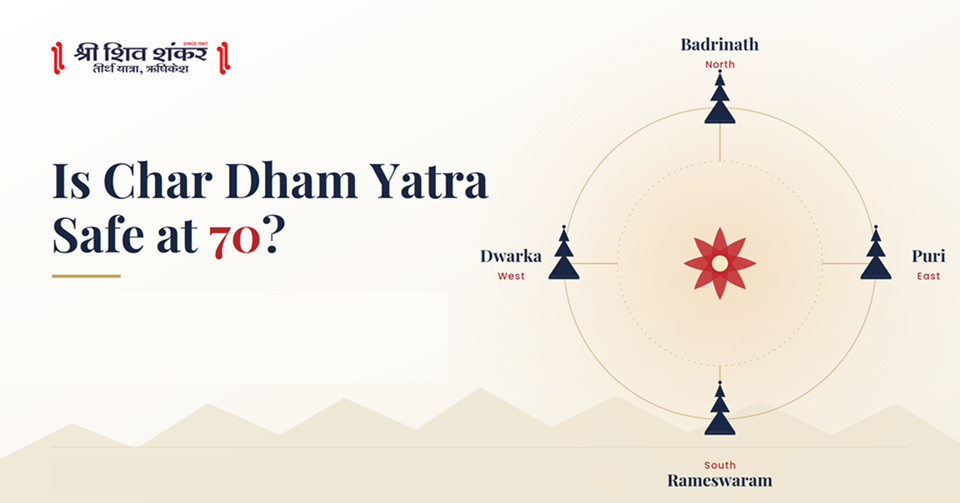
- Char Dham (the original four) — Badrinath in Uttarakhand, Dwarka in Gujarat, Jagannath Puri in Odisha, and Rameshwaram in Tamil Nadu. Adi Shankaracharya established these four dhams, covering the north, west, east, and south of India. This is the yatra this article is about.
- Chota Char Dham — Yamunotri, Gangotri, Kedarnath and Badrinath, all within Uttarakhand. This one involves high-altitude mountain trekking and is a completely different physical proposition.
If your parents say “Char Dham,” ask which one they mean. It is worth confirming this at the start, before any planning begins.
For a reasonably healthy 70-year-old, the original Char Dham is very achievable — provided the itinerary is long enough and paced properly.
There is no trekking. Every one of the four temples is reachable by road or rail. On any single day, the walking involved is far less than the Uttarakhand yatra demands.
The difficulty is cumulative. This is a journey of roughly 6,000 kilometres. Done properly, it takes three to four weeks. Your parent will sleep in a different bed most nights, eat food from four different regions, sit through long train journeys, stand in temple queues in coastal heat, and be a very long way from their own doctor for most of it.
Age itself is not the deciding factor. We have carried pilgrims of 78 who managed better than people twenty years younger. What decides it is stamina, heart health, blood pressure control, and honestly — temperament. A person who cannot sleep on a train, or who becomes anxious away from home, will struggle even in perfect health.
What Each Dham Actually Asks of An Elderly Body?
This is the table families ask us for most often, so here it is plainly.
| Dham | State | Altitude | What the pilgrim actually faces |
|---|---|---|---|
| Badrinath | Uttarakhand | ~3,133 m | The only high-altitude stop. The road reaches the temple area, then steps. Cold even in summer. Closed roughly November to April. |
| Dwarka | Gujarat | Sea level | Dwarkadhish temple has a significant flight of steps. Bet Dwarka needs a boat ride. Very hot April to June. |
| Jagannath Puri | Odisha | Sea level | Heavy crowds and long darshan queues. Steps at the main entrance. High humidity. Extremely crowded around Rath Yatra. |
| Rameshwaram | Tamil Nadu | Sea level | Long temple corridors mean a lot of walking. The 22 theertham ritual involves wet stone floors — a genuine slip risk for older pilgrims. Hot and humid. |
Read that with your parent in mind. Nothing there is a mountain climb. But Rameshwaram’s corridors are long, Puri’s queues are slow, and wet temple floors are how elderly pilgrims break hips.
The Risks Worth Understanding Before You Book
- Cumulative exhaustion. This is the real one. Day four is fine. Day nineteen is when a 72-year-old body starts refusing. Most problems on long yatras appear in the third week, not the first.
- Heat and humidity. Puri and Rameshwaram in the wrong months are genuinely dangerous for older people. Dehydration and heat exhaustion arrive quietly, and the early signs — confusion, weakness — get mistaken for tiredness.
- Crowds. Being pushed in a temple queue is a fall risk. A fall at 70 is not the same as a fall at 40.
- Stomach trouble. Four regions, four cuisines, four water sources. Digestive upset is common, and in an elderly diabetic or someone on blood pressure medication, a few days of it becomes a medical problem.
- Distance from your own doctor. If something happens in Rameshwaram, your cardiologist in Delhi is 2,500 km away and does not have the file in front of him.
- Altitude at Badrinath. Above roughly 2,500 metres, there is less oxygen in every breath, and the heart works harder to compensate. For a healthy heart, this is manageable. For a heart with existing blockage or uncontrolled blood pressure, it deserves specific medical advice before travel.
We do not say this to frighten anyone. We say it because families who understand the risks plan properly, and families who plan properly usually have a beautiful yatra.
Who Should Think Very Carefully Before Booking
Please discuss the yatra with your parent’s own doctor if any of the following apply:
- A heart attack, angioplasty, stent, or bypass in the last twelve months
- Uncontrolled high blood pressure
- Diagnosed heart failure or significant valve disease
- COPD, severe asthma, or any condition needing supplemental oxygen
- Uncontrolled diabetes, particularly with neuropathy affecting the feet
- Advanced kidney disease or dialysis
- Significant mobility limitation or a history of falls
- Dementia, or confusion in unfamiliar surroundings
- Recent major surgery
None of these is automatically a refusal. Some are. That decision belongs to the doctor who has seen the reports, not to a travel company, and not to an article on the internet.
The Medical Check To Do Before You Book
Do this in the month before you pay, not the week before departure.
Ask for a proper cardiac evaluation — ECG, echo, and a stress test if the doctor considers it appropriate. Get blood pressure assessed properly, not from one reading in a busy clinic. Check sugar control with HbA1c rather than a single fasting number. If there is any lung history, get pulmonary function tested. Have the feet checked if your parent is diabetic, because three weeks of temple walking on stone floors is hard on them.
Then ask the doctor this exact question: “Can this patient manage three to four weeks of continuous travel, including some days at 3,000 metres and some days in coastal heat?”
A general “he is fine” is not the same answer.
How to Make Char Dham Comfortable for a 70-Year-Old
- Give it more days, not fewer. The most common mistake families make is compressing the itinerary to save money or leave. A 25-day yatra with rest days is far safer than a 15-day rush covering the same ground.
- Pay attention to the season. Badrinath is closed roughly from November to April. Puri and Rameshwaram are punishing from April to June. This is precisely why many operators sell a Teen Dham combination instead — the four dhams do not share a comfortable season easily. Ask your operator how they have planned around this, so you know what the itinerary is built on.
- Consider train over road for the long stretches. A sleeper journey lets an elderly body rest lying down. Twelve hours in a bus seat does not.
- Choose a group yatra, not a private trip. Not for the company — for what happens if something goes wrong. A pilgrim who falls ill 2,000 km from home needs someone whose actual job is to handle it.
- Carry the medicines properly. A written list with generic names and doses, copies of prescriptions, enough supply for the full trip plus one extra week, and a one-page medical summary in a plastic folder that stays with the pilgrim — not in the checked luggage.
- Insist on regular satvik meals. Irregular and unfamiliar eating is the quiet cause of most illness on long yatras.
What Your Parents Should Expect
Honest expectations prevent most disappointment.
Days are long. Hotel standards in pilgrimage towns are basic; these are temple settlements, not tourist resorts. Toilets on the road are not always clean. Darshan queues can be long, particularly on festival days and weekends. The weather will swing from Himalayan cold at Badrinath to coastal humidity at Rameshwaram within the same trip, so packing has to cover both.
None of this is a reason not to go. It is a reason to prepare them, so that what they find matches what they were told.
Also Read: बुजुर्गों के लिए चार धाम यात्रा: सावधानियां और आसान तरीके
How We Look After Senior Citizens
This company began with one man, Shri Shiv Charan Lal Agarwal Ji, selling rakhi and holy books at Lakshman Jhula in Rishikesh. From that, over more than fifty years, it grew into a group that has now served over 2,60,000 pilgrims. The majority have been senior citizens, and everything about how we run a yatra was shaped by that.
Our staff is trained specifically for the needs of older pilgrims, including medical assistance in an emergency. Itineraries are paced so elderly travellers are not pushed into unnecessary strain. Meals are pure vegetarian and satvik, served at regular hours. On our train yatras, there is bhajan and satsang throughout the journey, which is why many pilgrims tell us the long days passed differently than they had feared. We are an ISO 9001:2015 certified organisation.
Planning Char Dham for Your Parents?
If you are considering this Char Dham Yatra for elderly parents and want an honest assessment of whether it suits them, speak to us before booking. We will tell you plainly if we think the answer is no.
Call: 0135-2436468 | WhatsApp: +91-9640100200 Address: 233 Bankhandi, Railway Road, Rishikesh, Uttarakhand 249201
Medical disclaimer: This article is general information, not medical advice. Every pilgrim’s situation is different. Please consult your own doctor before booking a long-distance pilgrimage.
Frequently Asked Questions
Q1. What is the difference between Char Dham and Chota Char Dham?
Ans: Char Dham refers to the four dhams established by Adi Shankaracharya — Badrinath, Dwarka, Jagannath Puri, and Rameshwaram — spread across four corners of India. Chota Char Dham means Yamunotri, Gangotri, Kedarnath, and Badrinath, all in Uttarakhand, and involves high-altitude trekking.
Q2. Is there an age limit for Char Dham Yatra?
Ans: There is no fixed upper age limit. What matters is fitness for sustained travel — the journey typically runs three to four weeks and covers around 6,000 km. Medical clearance is advisable for anyone over 70 or with a heart condition.
Q3. Which dham is hardest for elderly pilgrims?
Ans: No single one is hard. Badrinath is the only altitude stop. Rameshwaram involves the most walking, on long corridors and wet floors. Puri has the heaviest crowds. The real difficulty is the cumulative fatigue of the full circuit.
Q4. How many days does Char Dham Yatra take?
Ans: Covering all four dhams properly takes roughly three to four weeks. Shorter itineraries exist but compress travel in a way that is hard on older pilgrims.
Q5. Is Char Dham Yatra by train better for elderly parents?
Ans: For long distances, usually yes. A sleeper berth allows rest lying down, meals can be regular, and on organised yatras there is bhajan and satsang throughout the journey.
Q6. Should senior citizens get a medical check-up before Char Dham Yatra?
Ans: Yes. A medical check-up is advisable, especially for pilgrims above 70 or those with existing heart, blood pressure, breathing, or mobility concerns. A doctor can assess whether the planned itinerary and altitude are suitable and advise on any precautions or medications to carry.
Q7. What should elderly pilgrims carry for Char Dham Yatra?
Ans: Elderly pilgrims should carry prescribed medicines, basic first-aid supplies, comfortable walking shoes, warm clothing, rain protection, personal toiletries, important medical reports, and a list of emergency contacts. It is also helpful to carry medicines in sufficient quantity for the entire journey.
Q8. How can elderly pilgrims avoid excessive fatigue during Char Dham Yatra?
Ans: The best approach is to maintain a relaxed pace and avoid rushing between destinations. Take regular breaks, stay hydrated, eat light and nutritious meals, and get adequate sleep. A well-planned itinerary with sufficient rest days can make the journey much more comfortable for senior pilgrims.
Q9. Can elderly people undertake Char Dham Yatra without trekking?
Ans: It depends on the itinerary and the individual’s mobility. The traditional Chota Char Dham Yatra in Uttarakhand includes places where walking, steep paths, or other physical challenges may be involved. However, transport and assistance options can reduce the amount of walking required at some locations. The arrangements should be planned according to the pilgrim’s fitness and mobility.
Q10. What is the best way to plan Char Dham Yatra for parents above 70?
Ans: For parents above 70, comfort and safety should take priority over completing the journey quickly. Choose a slower itinerary, comfortable accommodation, reliable transportation, regular meal and rest breaks, and an organised yatra with experienced support staff. A pre-trip medical consultation and advance planning can also help make the pilgrimage more manageable.
Do you have any questions?
Feel free to give us a call. We have a team of experts ready to answer all your queries. Thank you.
Popular Posts

हिमाचल नौ देवी दर्शन यात्रा 2026: वैष्णो देवी, चामुंडा और नैना देवी के दर्शन कैसे करें?
हिमाचल प्रदेश की पहाड़ियों में स्थित देवी मंदिर अपनी धार्मिक मान्यताओं, प्राचीन इतिहास और शांत वातावरण के लिए प्रसिद्ध हैं। हर साल हजारों श्रद्धालु मां नैना देवी, मां चिंतपूर्णी, मां चामुंडा, मां ज्वाला जी और अन्य शक्तिस्थलों के दर्शन करने के लिए यात्रा करते हैं। यदि...
युवा पीढ़ी को तीर्थ यात्रा क्यों करनी चाहिए? जानिए इसके पीछे का महत्व
युवा पीढ़ी को तीर्थ यात्रा इसलिए करनी चाहिए क्योंकि यह मानसिक तनाव कम करती है, आत्म-अनुशासन सिखाती है, भारतीय संस्कृति और परंपराओं से जोड़ती है, डिजिटल दुनिया से ब्रेक देकर आत्म-चिंतन का अवसर देती है, और जीवन को एक नया उद्देश्य व दिशा प्रदान करती है। यह सिर्फ धार्मिक...
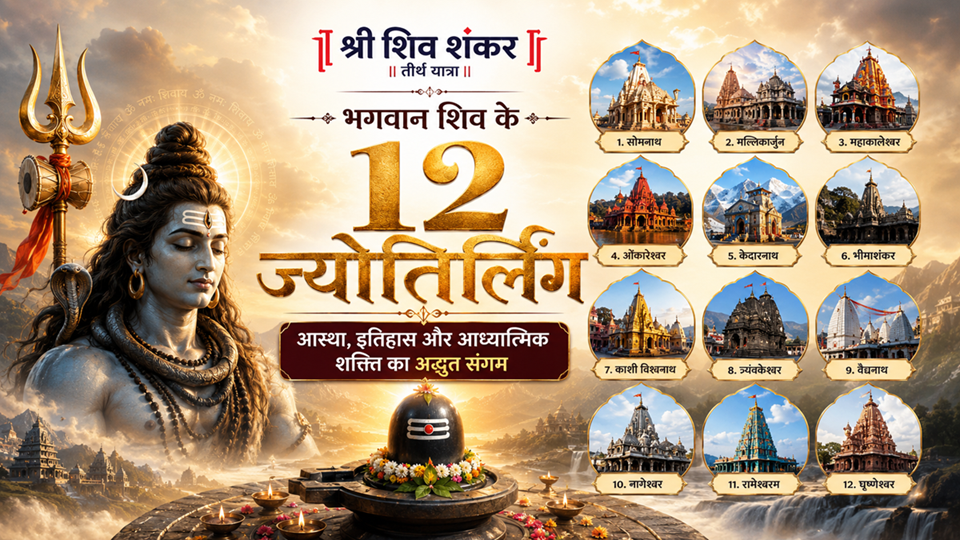
भगवान शिव के 12 ज्योतिर्लिंग: आस्था, इतिहास और आध्यात्मिक शक्ति का अद्भुत संगम
12 ज्योतिर्लिंग: आस्था और अध्यात्म कल्पना करिए—सृष्टि के आरंभ का वह क्षण, जब न धरती थी, न आकाश, न सूर्य, न चंद्रमा। केवल एक असीम शून्य था। और उस शून्य को चीरते हुए एक दिव्य प्रकाश का स्तंभ प्रकट हुआ, जिसका न कोई आदि था, न कोई अंत। न ऊपर से दिखता था, न नीचे से। बस था,...
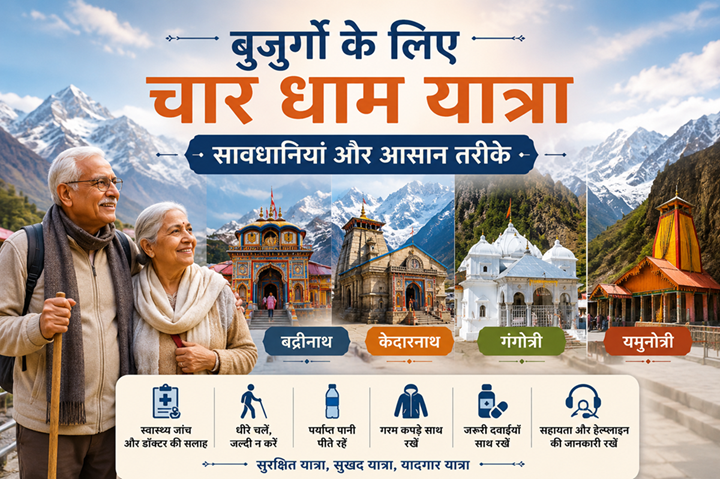
बुजुर्गों के लिए चार धाम यात्रा: सावधानियां और आसान तरीके
शुरुआत में बात करते हैं — क्या बुज़ुर्ग चार धाम यात्रा कर सकते हैं? जी हाँ, बिल्कुल कर सकते हैं। बहुत से लोग सोचते हैं कि चार धाम यात्रा सिर्फ जवान और तंदुरुस्त लोगों के लिए है। लेकिन ऐसा नहीं है। अगर सही तैयारी की जाए, सही समय पर जाया जाए, और कुछ ज़रूरी बातों का...
हिंदू धर्म में तीर्थयात्रा का महत्व क्यों है?
क्या आपने कभी सोचा है कि लाखों लोग कठिन रास्तों और कड़कड़ाती ठंड में भी पहाड़ों की ओर क्यों खिंचे चले जाते हैं? आखिर ऐसा क्या है जो उन्हें घर का आराम छोड़ने पर मजबूर करता है? वास्तव में, हिंदू धर्म में तीर्थयात्रा का महत्व क्यों है? इसे समझे बिना सनातन संस्कृति को...
Popular Categories

Devvrath Agarwal
Devvrath Agarwal Ji is the Director and Proprietor of Shri Shiv Shankar Tirth Yatra, a trusted pilgrimage organization based in Rishikesh. Carrying forward a family legacy of over 50 years, he is dedicated to helping devotees experience India's most sacred pilgrimage destinations with comfort and care. With a background in business management and a deep respect for spiritual traditions, he combines professional expertise with a commitment to service. Through his work and writing, he aims to make pilgrimage journeys accessible, meaningful, and enriching for devotees from all walks of life.